
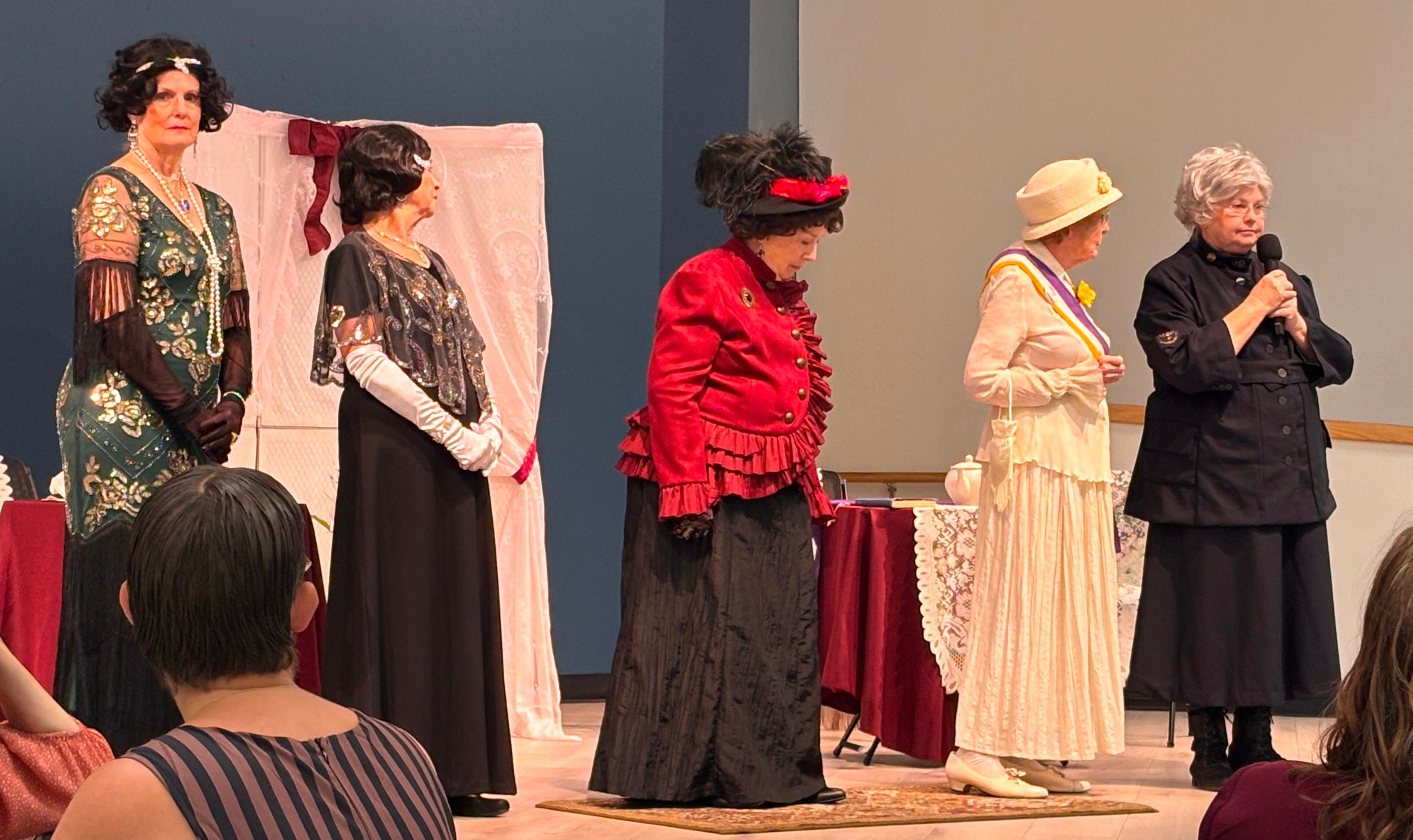
For years, my mother had encouraged my family to attend the Westminster Historical Society’s historic tea. Our schedules never seemed to cooperate, but this year they finally did. My wife and daughters came with me, and because my mother was among those helping organize the event, our primary motivation was fairly simple: we wanted to show up and support her.
What I did not know was what the afternoon’s entertainment would be. We arrived at The MAC, a Westminster community facility that the city describes as a hub for an “active adult lifestyle,” with a walking track, weight room, fitness programs, classes, and educational activities. Westminster, CO Sitting in a multipurpose room filled with tables, folding chairs, tea settings, and a small stage, I liked the symmetry of what was about to happen. This was a building where people regularly came to care for their physical bodies. That afternoon, we were about to exercise something else: our historical memory.
When history walked onto the stage
The entertainment came from The Legendary Ladies, a Colorado nonprofit performance organization founded in 1992. Their mission is to promote the history of women who made distinctive contributions to the American West, and their signature program, Unconventional Women of the West, uses first-person historical portrayals to bring those women back into the room.
Belle Starr had been listed in our printed program but was unable to appear. Instead, the afternoon included a portrayal connected to the women of the U.S. Army Signal Corps in World War I—the women commonly remembered as the “Hello Girls”—followed by Colorado suffragist Ellis Meredith, socialite and Hope Diamond owner Evalyn Walsh McLean, and actor and inventor Hedy Lamarr.
Those are four very different lives. A wartime telephone operator, a suffragist, a fabulously wealthy socialite, and a Hollywood movie star do not fit neatly into a single historical category. Yet as I listened, a common problem gradually became visible. Each woman’s story illustrated, in a different way, what can happen when the historical record recognizes only part of a life, delays recognition until decades later, or allows the easiest version of a person to overshadow the more complicated one.
I found myself thinking about the familiar phrase that history is written by the winners. The afternoon made me think that formulation is too simple. Historical memory is shaped not only by who “won,” but by who was able to create records, whose papers survived, who was considered worthy of an archive, who received a newspaper obituary, whose photograph was labeled, who appeared in a textbook, who was selected for a museum exhibit, and who eventually had someone care enough to reconstruct the story.
Recognition, citizenship, and the right to be counted
The story of the Hello Girls produced my strongest visceral reaction. In 1918, the U.S. Army Signal Corps sent 223 women to France as telephone operators. By the end of the war, they had connected more than 26 million calls, and Gen. John J. Pershing recognized the importance of their work. Yet when these women returned home, the government treated them as civilian employees rather than military veterans. Their fight for formal recognition lasted roughly six decades.
Congress finally acted in 1977, and after President Jimmy Carter signed the legislation, the surviving women became eligible for military discharges and veterans’ benefits. U.S. Department of Veterans Affairs During the performance, one sentence attributed to the woman being portrayed stayed with me: she had fought the government for so many years because she loved her country and wanted her country to be worth loving.
That formulation struck me. It describes a kind of patriotism that does not require pretending that institutions always behave justly. Instead, it asks enough of those institutions to insist that they live up to the values they claim.
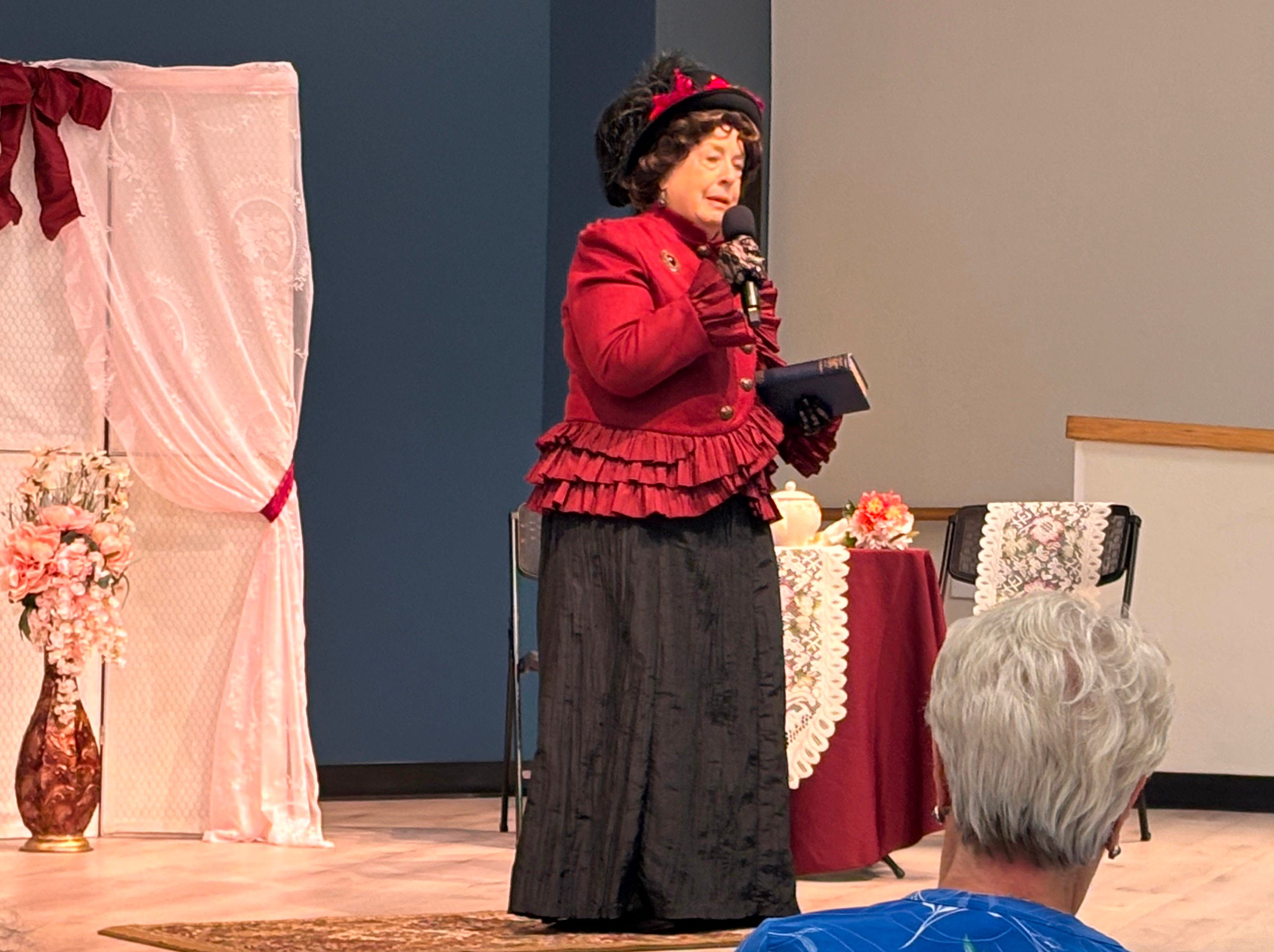
Ellis Meredith’s story affected me differently. Colorado voters approved women’s suffrage in 1893, making Colorado the first state where male voters approved equal suffrage through a popular vote. Meredith and Elizabeth Piper Ensley were among the women who helped lead that movement in Colorado and beyond. History Colorado The federal story took much longer. The 19th Amendment was added to the Constitution in 1920, prohibiting exclusion from the ballot on the basis of sex, although its passage did not eliminate the citizenship restrictions, discriminatory state laws, intimidation, and other barriers that continued to prevent many Black, Native American, Asian American, Latina, and other women from exercising the franchise equally. National Park Service
As a husband and the father of two girls, I find that history difficult to treat as an abstraction. I want my daughters to understand how recently rights that can feel inevitable today were anything but inevitable. I also want them to understand that progress did not happen automatically. People organized, argued, wrote, marched, voted, challenged institutions, and sometimes spent most of their lives insisting that they deserved to be counted.
That afternoon gave my daughters something I could not have engineered nearly as effectively myself: an outside voice saying that these stories mattered.
A postage stamp is a tiny monument
This is also where my interest in postal history began to connect with what I was hearing.
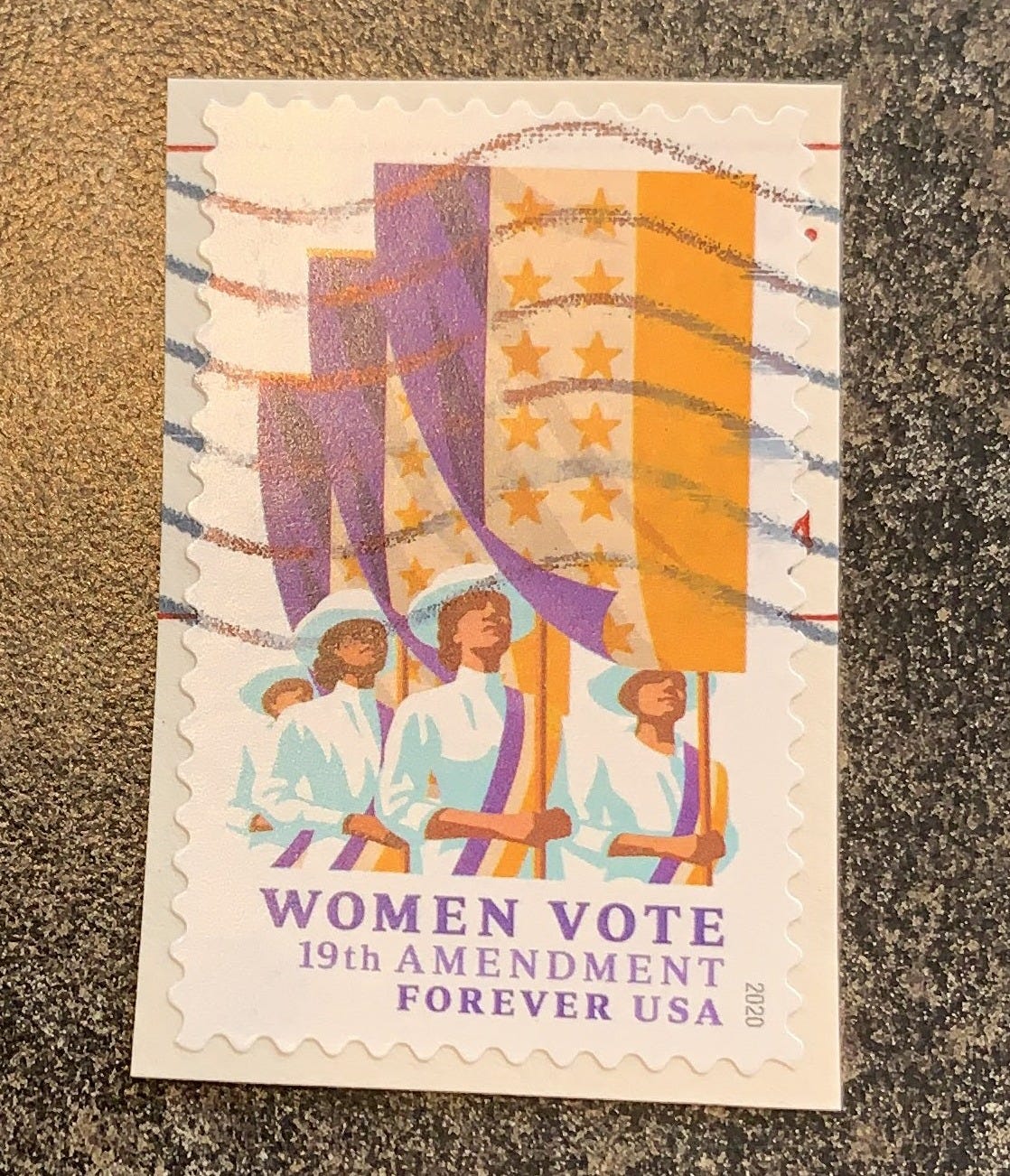
In 2020, the U.S. Postal Service issued the 19th Amendment: Women Vote Forever stamp for the centennial of ratification. Inspired by historical photographs, the design depicts marching suffragists in purple, white, and gold, the colors of the National Woman’s Party.
A postage stamp is tiny, but it is not insignificant. Stamps are among the small ways a nation constructs public memory. Someone has to decide which individuals, movements, places, and achievements deserve to appear on an object that may pass through millions of hands. For a postal historian, that makes a commemorative stamp something more than payment for delivery. It is a miniature monument.
There is a particularly uncomfortable postal juxtaposition in the Hello Girls story. In 1952, the Post Office Department issued a three-cent Women in Our Armed Services commemorative stamp showing women representing the Marines, Army, Navy, and Air Force. The stamp was not about the Hello Girls, but it celebrated women’s military service while surviving World War I telephone operators were still fighting to have their own wartime service formally recognized. Postal Museum
That is the kind of contradiction I find fascinating in postal history. What a country chooses to commemorate can tell us something about its ideals. The gaps between the commemoration and lived experience can tell us something too.
When public history suddenly became family history
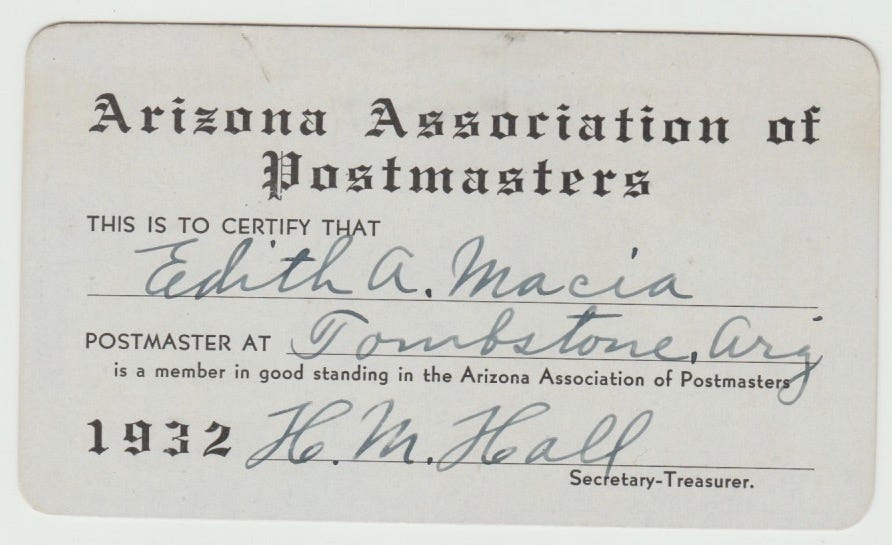
The most unexpected connection of the afternoon came through Evalyn Walsh McLean. Her story began in Colorado mining country. During the portrayal, I heard that she had been born in Leadville in 1886, and that date and place immediately caught my attention because my wife’s great-grandmother, Edith Alice Macia, had been born in Leadville in 1884.
Suddenly this was not only a story about a colorful woman from Colorado history. I was thinking about a woman in my own family.
Edith’s life eventually took her far from Leadville. The Congressional Record documents her 1928 confirmation as postmaster of Tombstone, Arizona. GovInfo Contemporary newspaper coverage later described her working undercover at the request of the FBI inside a Communist Party organization in California during the 1940s. Whatever judgments we make about the politics and methods of that era, it was an unusual life: Colorado mining country, family loss, Tombstone, the postal service, and undercover federal work.
After the performance, I told the woman portraying McLean about Edith. The response from The Legendary Ladies caught me completely off guard. They thought Edith sounded like someone who could make an interesting character for one of their own historical portrayals.
I nearly fell over.
There was something wonderfully circular about the moment. I had spent an afternoon watching women from the past restored to complexity through performance, and then a group devoted to that work suggested that a woman from my own family might herself be worthy of the stage. It reminded me that historical figures are not always waiting in textbooks to be discovered. Sometimes they are in our family photographs, letters, envelopes, census records, newspaper clippings, and stories that one generation remembers but the next may not.
The Hope Diamond went through the mail
Evalyn Walsh McLean also provided one of my favorite postal-history connections of the afternoon, although the most interesting postal episode actually came after her death.
McLean had owned the Hope Diamond, but after she died in 1947, jeweler Harry Winston eventually acquired it from her estate. In 1958, Winston donated the diamond to the Smithsonian Institution. How did one of the most famous gemstones in the world travel from New York to Washington?
Registered mail.
The Hope Diamond arrived at the Smithsonian in an ordinary-looking brown package. The National Postal Museum still preserves the wrapper. The postage itself cost just $2.44, while the total mailing charge was $145.29 because most of the cost purchased approximately $1 million in indemnity coverage. Winston regularly trusted registered mail with valuable gemstones. Smithsonian Natural History Museum
I love this story because it captures something that repeatedly draws me to postal history. Enormous stories often survive inside surprisingly ordinary containers. A plain envelope can document migration, war, grief, commerce, political change, family ties, or a life otherwise nearly forgotten. In this case, brown paper and postal markings document the journey of a 45.52-carat diamond into the national collection.
More than the part history remembers
Hedy Lamarr provided another variation on the same theme. Her name was not forgotten, but for many years the public story attached to it emphasized her beauty and Hollywood career far more than her inventive work.
Lamarr and composer George Antheil developed and patented a frequency-hopping communication system designed to reduce the possibility that radio-controlled torpedoes could be detected or jammed. Their U.S. patent was issued in 1942, and the National Inventors Hall of Fame describes the work as an important development in wireless communications. National Inventors Hall of Fame
Her story reminded me that historical erasure does not always mean disappearance. Sometimes a person’s name survives perfectly well while the person herself becomes flattened. The socialite becomes a diamond. The actress becomes a beautiful face. The military communications worker becomes a civilian helper. The suffragist becomes a line in a timeline.
The problem is not always that we forget people entirely. Sometimes we remember only the part of them that history found easiest to package.
The red links
By this point in the performance, my mind had moved naturally to Wikipedia.
I joined WikiProject Women in Red in April 2024. The project takes its name from Wikipedia’s visual language: when an article contains a link to a subject for whom no article yet exists, the link appears in red. Women in Red works to turn those red links blue by creating and improving biographies and other content about women and gender minorities. Wikipedia
The scale of the imbalance remains substantial. On September 26, 2026—the day of this event—Women in Red reported that 439,287 of English Wikipedia’s 2,152,015 biographies were about women, or 20.41 percent. When the project’s organizers first recognized the problem in 2014, the proportion was 15.53 percent. Wikipedia
Four out of every five English Wikipedia biographies are therefore still about someone other than a woman.
Statistics like that can remain abstract until an afternoon like this gives them faces. A red link looks trivial on a computer screen, but behind it may be a life waiting for someone to decide it deserves research. Someone must find reliable sources, establish notability, write the article, cite the evidence, and make the person visible within one of the world’s most frequently consulted reference works.
What struck me at the tea was how similar that act is to so many other forms of preservation. A Wikipedia editor decides to write the article. An archivist decides to preserve the papers. A family member labels the photograph. A museum records the oral history. The Postal Service selects a subject for a stamp. None of these acts is the whole of history, but together they influence who remains visible within it.
Museums are editors of memory too
That realization follows me directly into another part of my life. I currently serve as president of the Lafayette History Museum. Our mission is to showcase the history of Lafayette, and our strategic plan specifically calls for the museum to “collect and share more diverse stories,” including through oral histories and partnerships with community representatives. 2023-2028 LHM Strategic Plan The museum has also described its broader goal as telling a history of Lafayette that extends beyond its original mining focus and reflects the community more fully. Lafayette History Museum
I do not think museums are neutral storage buildings where history simply waits on shelves. Museums make editorial decisions constantly. We decide what to collect, what to display, which photographs receive labels, which oral histories get recorded, what appears in an exhibit, and how limited space is allocated among an almost unlimited number of possible stories.
During my presidency, I want one of the questions we ask consistently to be: Whose story are we not hearing?
That does not mean replacing one simplified history with another. It means recognizing that a fuller history often requires us to look deliberately beyond the people who were easiest to document in the first place. If an institution repeatedly finds itself preserving the stories of people who held similar positions of power and privilege, there is value in asking who lived alongside them but left a thinner archival trail.
The Legendary Ladies did this on a stage. Women in Red does it one Wikipedia article at a time. Museums do it through collections and interpretation. Families do it around kitchen tables and boxes of old photographs. Postal history can do it through the envelopes, cancellations, stamps, addresses, and correspondence that survive long after the people who created them are gone.
Look at the blank
That is ultimately what I hope someone takes away from this story. For the next few days, look at the world through the lens of representation. When you open Wikipedia, look at your children’s history assignments, walk through a museum, scan the books on your own shelves, watch a documentary, or look through a stamp album, pay attention to who occupies the space. Then pay attention to who does not.
If the books, exhibits, biographies, archives, or preservation projects around you have overwhelmingly centered men, consider making your next act of historical preservation about a woman. If there are women in your family whose accomplishments have become little more than a name and a date, ask questions while someone still remembers the answers. Tell the girls and women in your life that their ambitions matter, but also do something more durable: help create and preserve the records that will make their stories harder to overlook.
My wife, daughters, and I did not attend the Westminster Historical Society tea because I had planned a family lesson about women’s history. We went because my mother had been asking us to attend for years and, finally, our schedules aligned. The lesson was serendipitous.
That may be part of why it stayed with me.
On a small stage in a multipurpose room, several women from the past were given space to become complicated again. By the time I left, I was thinking less about whether history remembers people and more about the human choices behind that remembering.
A postage stamp is small. A Wikipedia article is only one page. A museum label may contain only a few paragraphs. A family story might begin with nothing more than a name written on the back of a photograph.
But each of them asks the same question:
Who have we decided is worth remembering?
AI use acknowledgment: I attended this event, took the photographs included here, and supplied my firsthand observations, personal reflections, family-history connections, and a transcript of the presentations. I used ChatGPT to conduct a reporter-style interview with me about the experience, help organize those materials, identify sources for historical fact-checking, and assist with drafting and revision. I selected the themes and arguments, reviewed the historical claims and linked sources, made the editorial decisions, and take responsibility for the final article.